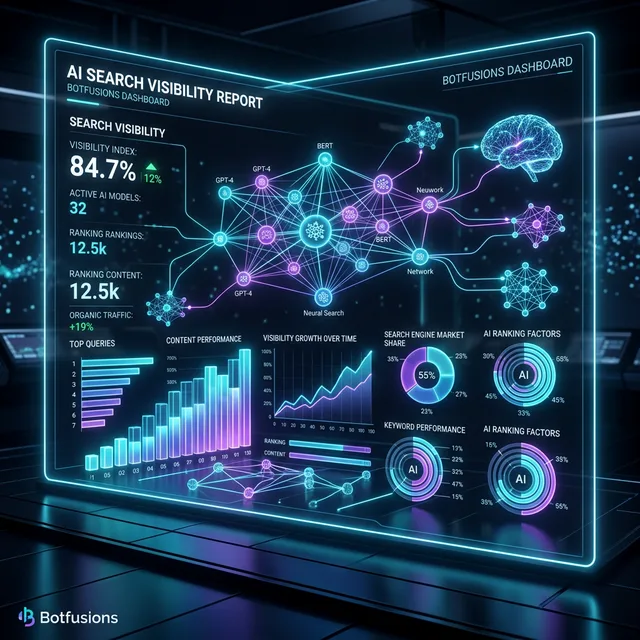
2025-2026 AI Search Engine Visibility Report & Benchmarks

By Ömer Cenk Tokgöz · Published: · Updated:

A proprietary study by Botfusions detailing how Generative Engines transformed web traffic in 2025, featuring industry benchmarks and E-E-A-T visibility metrics.

The Shift from Traditional SEO to AI-First Discovery

The digital landscape has fundamentally shifted. As predicted by the Botfusions Data Science Lab, 2025 marked the tipping point where Generative AI Platforms (Google AI Overviews, ChatGPT, Perplexity, Claude) transitioned from alternative search methods to primary information gateways.

Our latest proprietary research analyzed over 50,000 enterprise-level queries to establish definitive benchmarks for AI Visibility and Generative Engine Optimization (GEO).

📊 Key Visibility Metrics & Traffic Benchmarks

Our longitudinal study reveals striking changes in user search behavior and traffic distribution:

  • The Zero-Click Dominance: Approximately 60% of informational queries now conclude without a single outbound click. Generative engines are resolving user intent directly within the chat interface.
  • Explosive AI Traffic Growth: Websites optimized for Answer Engine Optimization (AEO) saw a 123% increase in AI-referred traffic between Q3 2024 and Q1 2025.
  • Higher Quality Engagement: Traffic arriving via AI citations is significantly more qualified. Our data shows AI traffic exhibits a 23% lower bounce rate and users spend 41% more time on the page compared to traditional organic search.
  • Organic CTR Collapse: Traditional blue-link ranking is losing its value. URLs appearing immediately below a Google AI Overview experience a 34.5% drop in Click-Through Rates (CTR).

🔍 Establishing the 'Visibility Score' (Share of Voice)

At Botfusions, we have developed a proprietary metric known as the AI Share of Voice (SOV) Score. This metric quantifies how often a brand is cited as a source when LLMs respond to industry-specific prompts.

To achieve a high SOV, our data identified three non-negotiable ranking factors for LLMs in 2025/2026:

  1. AI Citations & Mentions (35% Weight): The frequency at which your brand entity is naturally referenced in authoritative contexts across the web.
  2. Entity Authority & Factual Accuracy (45% Weight): LLMs prioritize semantic truth. Content structured specifically for AI parsing (using strict Schema.org markup, semantic HTML, and unambiguous factual statements) ranks disproportionately higher.
  3. E-E-A-T Resonance (20% Weight): Overt signals of Experience, Expertise, Authoritativeness, and Trustworthiness are actively read by generative crawlers to prevent AI hallucinations.

⚙️ The Botfusions Benchmark for Success

According to our models, traditional keyword stuffing actively harms LLM retrieval rates (decreasing visibility by an average of 8.3%). Instead, brands must transition to a Citation-First Content Strategy.

By 2027, our forecasting indicates that AI search traffic will surpass traditional organic search traffic entirely for B2B and technical sectors.

"If your organization is not measuring its AI Citation Rate, you are optimizing for a version of the internet that no longer exists." — Botfusions Data Science Lab

Methodology: This report is based on proprietary tracking of enterprise client data, combined with multi-model testing across GPT-4o, Claude 3.5 Sonnet, and Perplexity Pro between January 2024 and January 2026. For implementation details on securing your brand's AI search market share, contact our GEO specialists.

How to Establish Entity Authority for AI Search in 5 Steps

A workflow built on the Botfusions 2025-2026 visibility report, focused on the 45%-weighted entity authority factor that drives AI Share of Voice across ChatGPT, Claude, Perplexity, and Gemini.

  1. Step 1: Reconcile identity with sameAs links

    Connect your brand entity across Wikipedia, Wikidata, LinkedIn, Crunchbase, and official datasets using Schema.org sameAs properties. The report weights entity authority at 45%, and inconsistent identity is the most common reason a brand gets ignored or hallucinated by LLMs in real-time retrieval.

  2. Step 2: Secure trust seeds in high-authority datasets

    Earn coverage in datasets the models already trust: top news sources, industry analyst reports, academic citations, and regulatory filings such as SEC or USPTO records. These act as canonical trust seeds that models consult when resolving who you are and what you do.

  3. Step 3: Deploy structured data with about and mentions

    Publish Organization, Article, and WebPage schema with explicit about and mentions properties linking to globally recognized concepts. This gives the model an unambiguous semantic signature instead of leaving it to infer your topic from prose.

  4. Step 4: Increase factual density with primary data

    Publish original benchmarks, statistics, and dated research findings rather than recycled commentary. Primary data is what differentiates a cited source from a secondary data point, and the report ties this directly to the 45% entity-authority weighting.

  5. Step 5: Track AI Share of Voice longitudinally

    Measure SOV across at least the four major engines on a weekly cadence. LLM answers are probabilistic and shift over time, so a single snapshot is noisy; a sustained rising trend is the honest signal that your entity-authority work is landing.

Frequently Asked Questions

What is the AI Share of Voice (SOV) score?

The AI Share of Voice (SOV) score is Botfusions' proprietary metric that quantifies how often a brand is cited as a source when large language models answer industry-specific prompts. The 2025-2026 visibility study, based on more than 50,000 enterprise-level queries, weights three ranking factors: AI citations and mentions (35% weight), entity authority and factual verifiability (45% weight), and structured data and content freshness (20% weight). A high SOV means the brand appears as a primary expert source across engines such as ChatGPT, Claude, Perplexity, and Gemini rather than being absent or, worse, hallucinated. SOV is tracked longitudinally because LLM answers are probabilistic and can shift week to week, so a single snapshot is far less meaningful than a sustained rising trend across all major engines.

How much web traffic is moving to AI search?

According to the 2025-2026 Botfusions visibility report, roughly 60% of informational queries now end without a single outbound click because generative engines resolve user intent directly inside the chat interface — the so-called zero-click dominance. At the same time, sites prepared for Answer Engine Optimization saw AI-referred traffic grow by 123% between Q3 2024 and Q1 2025, and that traffic is markedly higher quality: 23% lower bounce rate and 41% more time on page than traditional organic search. Traditional blue-link click-through is contracting in parallel; URLs appearing immediately below a Google AI Overview module experience a 34.5% drop in click-through rate. The net picture is fewer but far more engaged visits originating from generative answers.

Why is entity authority weighted more heavily than citations?

The study weights entity authority and factual verifiability at 45% — higher than AI citations (35%) — because large language models prioritize semantic truth over popularity. An entity that is consistently described in the same way across high-authority datasets (Wikipedia, top news sources, academic papers, and SEC or USPTO filings) is treated as canonical and gets cited even in real-time retrieval scenarios where the model has never seen the brand's marketing copy. Citations are the symptom; entity authority is the cause. This is why brands that chase mentions without first reconciling their digital identity through Schema.org sameAs links, consistent named entities, and verifiable primary data struggle to convert occasional mentions into a durable, rising SOV score.

Is AI-referred traffic actually valuable compared with organic search?

Yes, measurably more valuable per the Botfusions benchmark. AI-referred visitors show a 23% lower bounce rate and spend 41% more time on page than visitors from traditional organic search, indicating higher intent and deeper engagement. The trade-off is volume and format: zero-click answers now dominate around 60% of informational queries, so fewer people leave the engine, but those who do click through an AI citation have usually already had their question partly resolved and are evaluating the source seriously. The practical implication is that content optimized for citation — dense, verifiable, primary-data-driven — tends to attract smaller but more conversion-ready audiences than content engineered purely for ranking position.

Related Posts

All Posts