How Much Does LLM SEO Consulting Cost? 2026 Pricing Guide
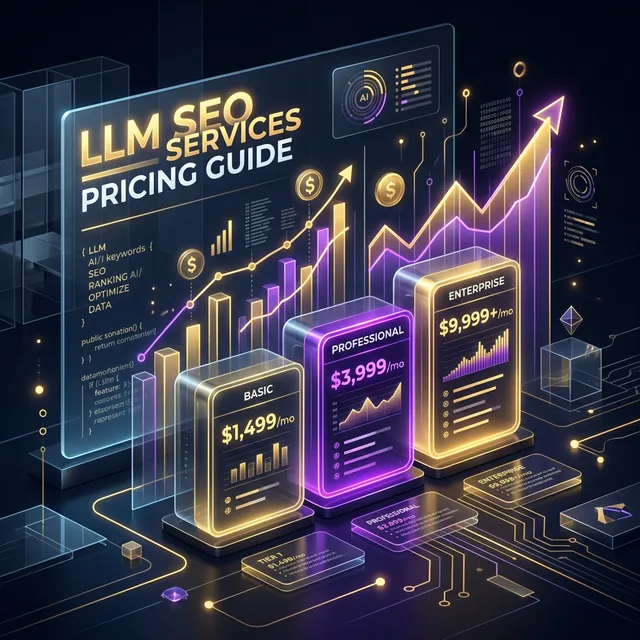
How much does LLM SEO cost in 2026? Pricing models, verified market benchmarks, how to measure ROI, and red flags — a transparent pricing guide.
Introduction: The New Economy of Search
In the early 2010s, "SEO" was about keywords and backlinks. By the early 2020s, it was about user intent and Core Web Vitals. In 2026, search entered its third — and most expensive — era: the LLM era.
So how much does LLM SEO cost? The honest answer: it depends, and the market is still the Wild West. One agency quotes $500 for an "AI audit," while a boutique firm demands a $50,000 retainer.
Gartner predicts traditional search volume will fall about 25% by 2026 as users move to AI chatbots. People now ask ChatGPT, Gemini, or Perplexity instead of typing "best X" into Google. As a result, visibility budgets are shifting — a change we map in our 2025-2026 AI Search Visibility Report.
This guide breaks down the 2026 pricing models, verified market benchmarks, hidden costs, and how to measure ROI.
The Three Main Pricing Models
Traditional SEO relies on volume-based packages. In contrast, LLM SEO pricing is driven by structure and complexity.
1. Monthly Retainers (Ongoing Optimization)
The most common model for businesses that need consistent visibility. LLMs refresh their data all the time, so optimization can't be a one-time event.
- Small business / local tier ($1,500 – $3,500 / month): Basic visibility, entity checks, and work on the 10-20 most critical prompts.
- Mid-market / scaling tier ($4,000 – $8,500 / month): Ongoing mapping, content vectorization, and mention tracking across 5+ AI engines.
- Enterprise tier ($10,000 – $50,000+ / month): Global brands with thousands of SKUs. Programmatic SEO, custom Knowledge Graph injection (GAR), and daily hallucination checks.
2. Project-Based (Audits and Setup)
Many companies start here before a retainer, often with a dedicated AI visibility audit.
- AI visibility audit ($2,500 – $7,500): A deep look at how ChatGPT, Gemini, and Perplexity see your brand today. Flags risky mentions and hallucinations.
- Foundational GEO build ($5,000 – $15,000): A one-time fix to your site's tech, Schema, and core content so it becomes machine-readable.
- Authority buildout ($15,000 – $50,000+): Earning the external citations that make your brand a "ground truth" entity for the LLMs.
3. Hourly Strategic Consulting ($250 – $600 / hour)
Used mainly by CMOs and CTOs who have an in-house team but need a "GEO architect" to steer strategy.
Verified Market Benchmarks: LLM SEO vs. Classic SEO
Let's be transparent. The figures above reflect our market view, and no authoritative pricing survey exists yet for GEO. The best reference point is therefore classic SEO. GEO usually adds a 20-50% premium over a similar classic-SEO scope.
Start with classic SEO. Ahrefs polled 439 providers and found an average retainer of $2,917/month. The most common band is $501 – $1,000 (23% of providers). Agencies average $3,209/mo; freelancers, $1,348/mo; consultants, $3,250/mo.
On hourly rates, the average is $111. Agencies charge about $99, consultants about $171, and freelancers about $72. Most work runs on retainer (78%), then project (49%) and hourly (35%).
Neil Patel's 500-firm survey shows most firms spend $500 – $7,500/mo. About 10% spend over $20,000, and 4% over $50,000. WebFX lists the enterprise band at $10,000 – $50,000+/mo.
What this means: A reputable GEO agency charges more than a similar classic-SEO retainer. The reason is extra load: multi-engine monitoring, entity engineering, and content vectorization. However, watch out if a vendor offers the same scope at classic-SEO prices under an "AI SEO" label. That is usually rebranded traditional SEO. We cover this red flag next.
What Drives the Cost
For example, if a quote looks unusually high or low, one of these five variables is usually why.
1. Platform Coverage
Tracking Google AI Overviews is fairly simple. Tracking Perplexity, Claude, ChatGPT Search, Gemini, and Meta AI at once takes far more tools — and costs more.
2. Content Volume and Type
A 100-page service site is not the same job as a 10,000-page store. Models read product pages differently from blog posts.
3. Technical Setup: RAG vs. Observation
- Observational SEO: Watching mentions and making small content tweaks (cheaper).
- Architectural GEO: RAG readiness, content vectorization, and Knowledge Graph work (pricier).
4. Competitive Landscape
In a tough niche like "best AI chatbot for law firms," the authority bar to displace a rival is higher. Therefore, your cost rises too.
5. AI Tooling Costs
Most agencies pay $500 – $2,000/month for tools like Profound or Otterly.AI Premium. Those costs usually end up in your retainer.
Proving ROI: It's About Measurability, Not Just Cost
The most common question we hear is simple: "I'll pay $5,000/month, but how do I measure the result?" It's a fair question. For instance, Google Search Console and Analytics don't show visibility inside AI answers. That gap is the market's biggest trust problem.
To prove ROI, you need a three-layer measurement stack:
- AI visibility tracking: Tools like Profound, Peec.ai, Otterly.ai, or AthenaHQ count how often your brand is cited in ChatGPT, Gemini, and Perplexity. At Botfusions, we plug this layer into our own measurement system. The goal is a clear number every month, not a vague "visibility went up."
- Citation traffic: Track clicks from AI answers as their own channel in Analytics, using UTM-tagged links.
- Conversion and cost comparison: Moreover, compare the cost of an AI-sourced lead against PPC and classic organic. Brands recommended by AI tend to convert better, because users see the pick as objective advice.
The rule is simple: an agency that won't commit to measurement can't improve. Therefore, when you evaluate a proposal, always ask: "Which tool, how often, and in what format will you report visibility?"
Pricing by Business Stage
Stage 1: The High-Growth Startup
- Goal: Show up in Perplexity "best of" lists and niche ChatGPT picks.
- Audit: $2,500 (one-time).
- Monthly retainer: $1,800 – $3,000.
- Deliverables: Monthly visibility report, gap analysis for 20 core queries, basic Schema work, and 2-3 optimized articles per month.
Stage 2: The Mid-Market Scale-up ($10M – $50M revenue)
- Goal: Defend share against incumbents and own the answer-engine space for high-volume queries.
- Audit: $5,000 – $7,500.
- Monthly retainer: $5,000 – $12,000.
- Deliverables: Bi-weekly mapping, entity precision work, digital PR for authority, and full RAG readiness.
Stage 3: The Global Enterprise
- Goal: Control the story across 100+ markets and protect the brand from hallucination and omission.
- Audit: $15,000 – $50,000.
- Monthly retainer: $25,000+.
- Deliverables: Structured-data and knowledge-graph work, brand-risk monitoring, and prompt-set maintenance.
Red Flags: Which Proposals to Avoid
It's often easier to drop an agency than to pick one. Therefore, walk away if you see any of these:
- "Guaranteed AI ranking" promises. No one owns an AI model's weightings — not Google, not ChatGPT. "Page 1 on Perplexity" is an outdated sales line.
- AI-washing (rebranding). Some shops resell classic SEO at a premium under an "AI SEO" label. The test: "Do you have multi-engine AI visibility tracking, and what's your method?" If the answer is vague, it's classic SEO.
- No measurement. An agency that won't share a regular, comparable AI-visibility report can't prove results.
- Opaque, fixed packages. Anyone pushing a fixed package without studying your site first usually doesn't get the work.
- Secret methods. "We have a proprietary method" with no detail usually means there's no method to share.
Case Study: The $100,000 Hallucination
Why would a firm pay tens of thousands a month just to "monitor"? Consider a mid-sized fintech in late 2024.
ChatGPT began telling users the firm "charged a 5% hidden fee" on transfers. That was false. For three weeks, every high-intent user heard the lie. The firm saw a 22% drop in new sign-ups before its team even noticed.
As a result, skipping monitoring cost an estimated $120,000 in lost lifetime value (LTV) in one month. In other words, a few thousand a month for monitoring isn't a marketing cost — it's business-continuity insurance.
Comparison Table: How to Invest Your Budget
| Feature | In-house Team | Traditional SEO Agency | Specialized GEO Agency | Botfusions (Agentic) |
|---|---|---|---|---|
| Est. monthly cost | $8,000 – $15,000 | $2,500 – $5,000 | $5,000 – $15,000 | $500 (Growth) – custom |
| Strategy depth | High | Low (outdated) | Very high (niche) | High (data-driven) |
| Technical depth | Medium | Very low | High | Very high (engineering) |
| AI visibility measurement | Variable | None | Yes | Yes (multi-engine measurement) |
| Turnaround | Slow | Medium | Medium | Fast (24/7 agents) |
What This Looked Like on Our Own Site
To keep the budget lines in this post from staying abstract, here is where the money and time actually went on our own site. We expected the weight of the work to sit in content production. It did not.
Most of the engineering hours went to serving JavaScript-rendered pages to bots as static HTML, to schema consistency, and to the automated checks that prove neither has broken. A concrete example: a single date-format mistake had made the publish date invisible to search engines across 104 blog pages. The content was fine; the carrier layer was broken. Fixing it was not a content task, it was a build task.
The budgeting rule that follows: a proposal selling you "AI-specific content" may be spending most of your money in the wrong place. When comparing quotes, ask separately how many hours go to technical accessibility and to validation. That is usually the invisible line item that decides the outcome.
Frequently Asked Questions
Is LLM SEO cheaper than Google SEO?
On a scope basis, yes. AI search favors authority and semantic density over backlink count. As a result, you can often see results at a lower total spend than classic link-building, which can run $10,000/month on its own.
Should I pay for "guaranteed AI rankings"?
No. No one owns an AI model's weightings. A consultant promising "source #1 on ChatGPT" is using an outdated tactic. The right goal is authority building and a measurable visibility lift.
How long until I see results?
In a real GEO engagement, the first visible movement shows up in 2-3 months. A meaningful, measured jump takes 4-6 months. So a "guaranteed result in three months" promise is a red flag — AI models need time to re-train and re-crawl.
Is $500 – $1,000/month enough?
That band usually buys basic observational SEO: mention tracking and small content tweaks. It is not enough for true architectural GEO — RAG readiness, entity work, and multi-engine measurement. If that's your budget, start with a full one-time audit instead.
Freelancer or agency?
A freelancer works if you need one specialist and will run measurement yourself. However, if you need multi-engine monitoring, engineering, and regular reporting, it's a team job. An agency fits better. Compare the top LLM SEO consulting agencies in the US.
Why is the Botfusions setup fee higher than the monthly fee?
Because most GEO work is structural. Once we make your site agent-readable and inject your data into Knowledge Graphs, maintenance is mostly monitoring and small nudges. Accordingly, we charge for the GEO engineering value we deliver, not for busy-work.
A 2026 LLM SEO Budgeting Template
For instance, if you must justify the spend to your CFO, structure your 2026 budget like this:
| Line item | % of digital budget | Purpose |
|---|---|---|
| Generative-engine auditing | 5% | Hallucination and accuracy scanning across LLMs. |
| Latent-space mapping | 10% | Making sure your brand shows in the right concepts and categories. |
| Agentic content production | 20% | High-authority, machine-readable data. |
| Traditional SEO maintenance | 40% | Core site health and Google ranking safety. |
| Paid AI in-feed placement | 25% | (Emerging) Direct spots inside AI search interfaces. |
Tip: Early movers can starve rivals of visibility. Consequently, since LLMs train on past data, if you own mentions today, you become the ground truth for the models trained tomorrow.
Conclusion: Value-Based Budgeting for the AI Era
In 2026, your search budget shouldn't be 100% Google. A healthy split usually looks like this: 50% traditional SEO (keeping current organic traffic), 40% GEO/LLM SEO (reaching AI-search users), and 10% experimental AI channels (voice search, AI social agents).
A fair price moves you from a bystander to a primary source. If you aren't paying for engineering, measurement, and data science, you aren't doing LLM SEO.
Want to know what a GEO strategy would cost for your brand? At Botfusions we start with a full analysis — get a free audit from our strategy team.
Sources: Ahrefs SEO Pricing Poll (439 providers); Neil Patel SEO Pricing Survey (500 firms); WebFX SEO Pricing 2026; Semrush SEO Pricing; Gartner search-volume forecast.

Ömer Cenk Tokgöz — Founder, Botfusions
Founder of Botfusions; focuses on Generative Engine Optimization (GEO) and AI / answer-engine visibility. Author of the AI Visibility methodology.
Author profile & areas of expertise → · Editorial standards →