What Is an AI Visibility Score and Why Does It Matter for Your Brand?
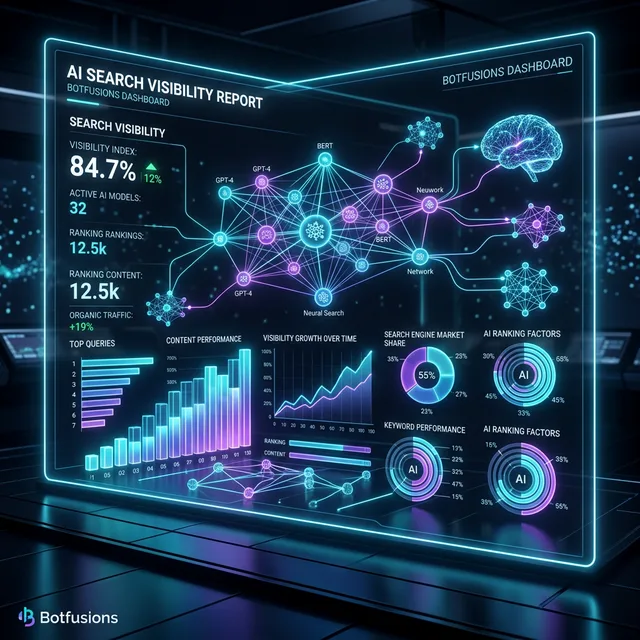
An AI visibility score is a composite 0–100 metric of how much generative engines cite and recommend your brand. This guide defines it, breaks down its weighted factors (Mention, Position, Citation, Sentiment, Share of Voice), and explains why it matters.
An AI visibility score is a composite 0–100 metric that measures how often your brand is mentioned, cited, and recommended inside the answers of generative engines like ChatGPT, Claude, Gemini, Perplexity, and Google AI Overviews. It blends weighted factors — Mention Rate, Position, Citation Rate, Sentiment, and Share of Voice — because buyers now make purchase decisions inside these engines.
What Exactly Is an AI Visibility Score?
An AI visibility score measures brand performance not at a single point but across a prompt set. A fixed, reproducible set of category prompts (e.g., "best B2B social listening tool", "best AI visibility tool") is run across engines like ChatGPT, Claude, Gemini, Perplexity, and Google AI Overviews; each answer is scored on whether the brand name appears (Mention Rate), where it appears in the answer (Position), whether it is cited as a source (Citation Rate), how it is framed (Sentiment), and its share versus competitors (Share of Voice). These sub-signals are weighted into a single composite score from 0 to 100.
The score's power is that it differs from traditional rank measurement. Classic SEO ranks a URL; AI visibility measures whether your brand is recommended inside a conversation. Gartner forecasts traditional search engine volume will drop roughly −25% by 2026 (Gartner, 2024 forecast) — a structural shift that silently erodes visibility for any brand that fails to move its measurement from blue links to conversational answers. The score summarizes where you stand on this new surface in a single number. (You can follow what GEO is in our GEO definition blog.); the score is your brand's AI-era visibility map, separate from traditional SEO.
The Weighted Factors Behind the Score
The table below shows the typical components of an AI visibility score with example weights (This is an example weighting; it varies by provider, but the total always normalizes to 100%):
| Component | Typical Weight | What It Measures | Why It Matters |
|---|---|---|---|
| Mention Rate | ~25% | Brand name appears in answer | Baseline presence; you cannot be recommended without being mentioned |
| Position | ~20% | Location in answer (first/middle/last) | Users read the first paragraph; top placement is the behavioral win |
| Citation Rate | ~20% | Cited as a source | Authority transfer; provides a clickable link |
| Sentiment | ~15% | Positive/neutral/negative framing | Recommendation tone; a negative mention depresses the score |
| Share of Voice | ~15% | Share vs. competitors | Relative position; tells you whether you are winning |
| Engine/Prompt Coverage | ~5% | How many engines × prompts measured | Robustness; a single engine and prompt is misleading |
The weights matter: having a mention alone is not enough. A brand may appear in an answer but be framed negatively, or appear without being cited as a source. The score combines these six signals into one number, turning qualitative intent into quantitative measurement.
Why Does It Matter for Your Brand?
Panel research indicates roughly 70% of B2B buyers research on AI engines like ChatGPT, Perplexity, Claude, and Gemini before purchase. That means the AI visibility score is tied directly to pipeline: answers where you are invisible become lost opportunities.
The score also offers measurable ground exactly where traditional SEO falls short. Academic literature shows that traditional SEO techniques (backlinks, titles, keywords) alone produce about −8.3% lift in AI answers (Aggarwal et al., 2024, KDD '24) — meaning the techniques that push you up the blue-link SERP do not work in conversational answers. What moves the score is a different optimization discipline: quotation integration lifts visibility by +40.8% (Aggarwal et al., 2024, KDD '24), statistical density adds +30.6% (Aggarwal et al., 2024), and citing sources adds +27.5% (KDD '24 Insights). The score reports the effect of these optimizations in a single, trackable number.
An important honesty note: AI visibility is not a metric that grows without bound. On the academic GEO-bench benchmark, the ceiling sits around ~40% — no brand can be 100% visible on every prompt. The score should be tracked against realistic expectations (a %20–%35 band is a strong target within your category) and "high score" should be read as relative to competitors, not absolute.
What Is a Good AI Visibility Score?
There is no single "good" threshold, because the score depends on category and competitor density. Practical anchors:
- 0–10%: Your brand is largely invisible in AI answers. Urgent GEO intervention needed.
- 10–25%: Visible on some prompts but competitors outrank you. Wide opportunity.
- 25–40%: Category-leader band. Strong citability, solid entity grounding.
- 40%+: Near the GEO-bench ceiling; sustainability becomes harder, monitoring turns defensive.
The trend matters more than the absolute value: a score rising quarter over quarter signals that the right GEO execution is in place (we detail how to lift the score in our GEO implementation methodology guide). A single measurement is less valuable than tracking it as a trend — which is what we explain in our AI Visibility Monitoring guide.
How Is the Score Calculated? (Quick View)
Calculation loops through five steps: (1) Define a category prompt set (e.g., 100–300 high-intent questions); (2) Run it across engines (ChatGPT, Claude, Gemini, Perplexity, AI Overviews); (3) Score each answer on the six signals; (4) Compute the weighted total; (5) Normalize against competitors. Methodology transparency is critical: a 20-prompt monthly single-engine snapshot is not the same signal as an 8-engine daily matrix. Always ask the provider for the prompt set, engine coverage, and cadence.
Bottom Line
An AI visibility score is the composite metric that measures your brand's real presence in the AI era. Traditional rank tracking is giving way to brand presence inside conversational answers, and buyers now decide inside those answers. The score unifies Mention, Position, Citation, Sentiment, Share of Voice, and Coverage signals into a single trackable number, providing an objective ground to prove your GEO work moves the needle quarter over quarter. First step: measure a baseline score, then move it by following the GEO implementation methodology.
Raise Your AI Visibility Score in 4 Steps
A practical 4-step action plan: measure your baseline, build the schema/llms.txt infrastructure and citable content, and iterate quarter over quarter.
Step 1: Measure your baseline score
Define a fixed category prompt set (100–300 queries) for your brand and 3–5 competitors, then run it across ChatGPT, Claude, Gemini, Perplexity, and AI Overviews. Record baseline Mention Rate, Position, Citation Rate, Sentiment, and Share of Voice. This number is the reference point that will prove all future progress.
Step 2: Set up schema, llms.txt, and entity grounding
Place a clean llms.txt at the root; deploy Organization, Article, FAQPage, and HowTo JSON-LD schema; interconnect entities with consistent @id values. This is the technical layer that lets AI engines retrieve and cite you correctly.
Step 3: Produce citable content
Open every key page with a 40–60 word factual summary, raise factual density to at least one statistic/date per 100 words, and add inline source citations. Quotation integration produces +40.8% lift (Aggarwal et al., 2024), statistical density +30.6% (Aggarwal et al., 2024).
Step 4: Iterate on the same prompt set
Re-measure the score on a monthly or quarterly cadence, compare to the Step 1 baseline, and convert remaining gaps into the next round of schema and content fixes. Track the trend more than the absolute value — the trend is the proof that execution is working.
Frequently Asked Questions
What is an AI visibility score, in short?
In short: It is a composite 0–100 metric measuring how much generative engines like ChatGPT, Claude, Gemini, Perplexity, and Google AI Overviews cite and recommend your brand. It blends weighted factors such as Mention Rate, Position, Citation Rate, Sentiment, and Share of Voice.
What is a good AI visibility score?
There is no absolute threshold; it depends on category and competitor density. A 25–40% band within your category is a strong target. The GEO-bench ceiling sits around ~40%, so 'good' should be read relative to competitors, not absolute. The trend matters more than the absolute value.
How is an AI visibility score calculated?
In five steps: (1) Define a fixed category prompt set; (2) Run it on ChatGPT, Claude, Gemini, Perplexity, and AI Overviews; (3) Score each answer on six signals; (4) Compute the weighted total; (5) Normalize against competitors. Methodology transparency is critical — always ask for the prompt set, engine coverage, and cadence.
How do I raise my score?
The score is moved by quotation integration (+40.8%; Aggarwal et al., 2024), statistical density (+30.6%; Aggarwal et al., 2024), and citing sources (+27.5%; KDD '24). Practical path: publish a clean llms.txt, deploy JSON-LD schema, and feed content with citable 134–167-word passages. We detail execution in our [GEO methodology guide](/en/blog/22).
How is this different from a traditional SEO score?
Traditional SEO ranks a URL; an AI visibility score measures whether your brand is recommended inside a conversational answer. Traditional techniques alone produce about −8.3% lift in AI answers (Aggarwal et al., 2024) — meaning what works on blue links does not work here. The score is a different discipline that measures brand presence.
Which engines does it cover?
Typically ChatGPT, Claude, Gemini, Perplexity, and Google AI Overviews. Engine/Prompt Coverage is itself a component: a single engine and a few prompts is misleading. Score robustness depends on how many engines × prompts × cadence you measure.

Ömer Cenk Tokgöz — Founder, Botfusions
Founder of Botfusions; focuses on Generative Engine Optimization (GEO) and AI / answer-engine visibility. Author of the AI Visibility methodology.
Author profile & areas of expertise → · Editorial standards →