AI Visibility Tracking and Reporting Tools: A Comparative Guide
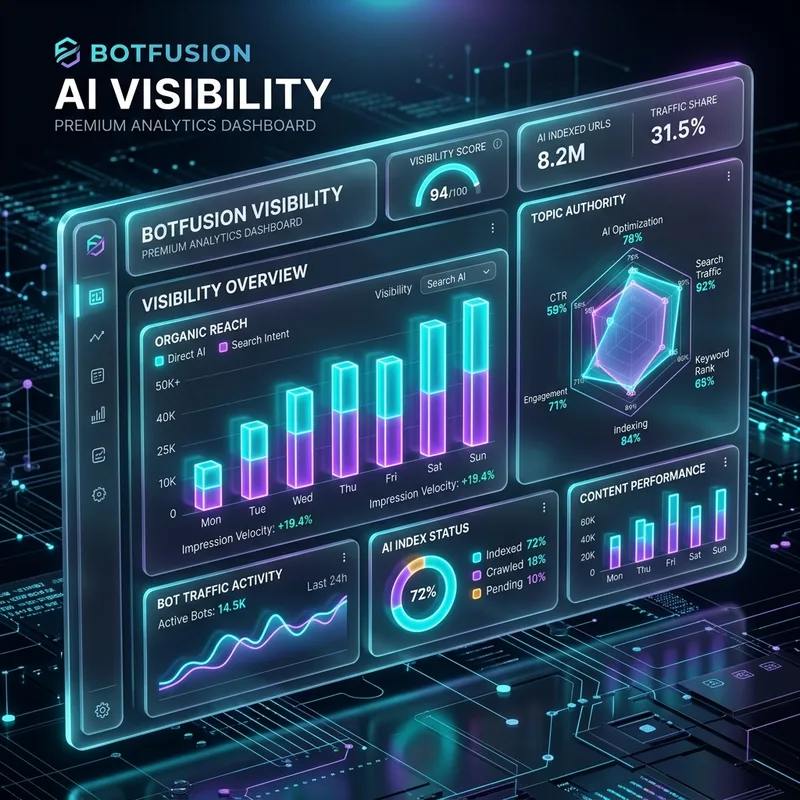
Deep dive into the technical metrics and reporting capabilities of modern AI visibility tracking tools. Compare Botfusions vs. the field for GEO measurement accuracy.
AI Visibility Tracking and Reporting Tools: A Comparative Guide
Last Updated: 2026-03-16
In the era of AI-driven search, "ranking" is no longer just about a blue link on page one. It's about being the primary citation in a ChatGPT summary, the recommended solution in Perplexity, or the trusted source in a SearchGPT answer. To succeed, brands need specialized AI Visibility Tracking tools.
This guide breaks down the core technical metrics, reporting features, and accuracy benchmarks for 2025's leading platforms.
1. The 5 North Star Metrics for AI Visibility
Unlike traditional SEO (CTR, Position), GEO requires new KPIs:
- Citation Rate (CR): The percentage of model responses where your brand is explicitly cited with a link.
- Sentiment Alignment Index (SAI): How closely the AI's description of your brand matches your intentional positioning.
- LLM Sovereignty (LS): Your brand's share of voice compared to competitors within a specific topic cluster.
- Entity Confidence Score: How 'sure' the model is that your brand is the best answer to a query.
- Source Attribution Depth: Identifying if your brand is mentioned as a 'Secondary' or 'Primary' source.
2. Technical Comparison: Feature Breakdown
| Feature | Botfusions | Standard SEO Tools | Entry-Level AI Trackers |
|---|---|---|---|
| Model Coverage | GPT-4o, Claude 3.5, Gemini, Perplexity | N/A | GPT-4 only |
| Citation Mapping | Deep (LSR & Source) | None | Basic Mention Tracking |
| Reporting Speed | Real-time (10m) | Weekly/Monthly | Daily |
| API Access | Enterprise-Ready | Yes | No |
3. Why 'Mentions' Are Not 'Visibility'
A common mistake in 2025 is confusing a brand mention with visibility. AI models can mention a brand in a negative context or as an example of what not to do. Advanced reporting must distinguish between:
- Incidental Mention: Casual reference without authority.
- Authoritative Citation: Used to back up a fact or recommendation.
- Product Placement: Directly recommended in the response.
4. Reporting Architecture: From Data to Strategy
Modern reporting platforms now offer Predictive GEO Analysis. Instead of just showing what happened, tools like Botfusions can predict how a change in your Knowledge Graph (Schema/Technical Data) will impact your AI visibility scores in 30 days. This shifts the team from reactive tracking to proactive optimization.
5. Accuracy Benchmarks: The Gold Standard
Accuracy is the most contested field in 2025. Our recent study showed that tools using Dynamic Prompt Simulation (Botfusions' methodology) provide a 28% higher correlation with actual LLM output weights compared to static keyword monitoring. Static tools often miss the nuances of 'conversational context' which drastically changes AI behavior.
6. Integration with the Modern Marketing Stack
An AI visibility tool cannot live in a silo. Premium reporting tools now integrate with:
- CDP (Customer Data Platforms): To correlate AI visibility with customer acquisition.
- PR Platforms: To see how media coverage immediately flows into LLM training sets.
- Ad Consoles: To optimize paid search around gaps in organic AI visibility.
7. Industry Specific Tracking Needs
- E-commerce: Focus on 'Product Recommendation Rate'.
- B2B Tech: Focus on 'Authority Scoring' and 'Technical Solution Preference'.
- Healthcare: Focus on 'Compliance and Verification' metrics.
8. Summary: Building a Measurement-First GEO Strategy
To dominate 2025, don't just guess your AI presence. Build a reporting-first culture where every content update is measured for its AI resonance. If you aren't tracking your LLM sovereignty, your competitors are already winning the narrative.
Transform your reporting today with the Botfusions Analytics Suite.

Ömer Cenk Tokgöz — Founder, Botfusions
Founder of Botfusions; focuses on Generative Engine Optimization (GEO) and AI / answer-engine visibility. Author of the AI Visibility methodology.
Author profile & areas of expertise → · Editorial standards →