Entity and Knowledge Graph Optimization: The 2026 Strategy for AI Search Dominance
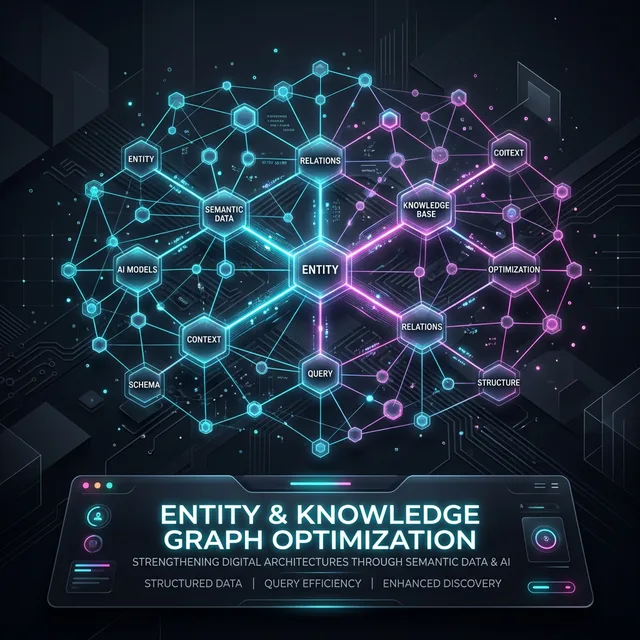
Move beyond keywords. Learn how to optimize your brand as a 'Verified Entity' in the Knowledge Graphs of GPT-5, Gemini, and Claude for maximum GEO performance.
🌐 The Shift from Keywords to Entities
In the era of Generative Engine Optimization (GEO), AI models don't just 'crawl' text; they build relationships between concepts. These relationships form a Knowledge Graph. If your brand isn't a recognized 'Entity' with verified connections, you are invisible to AI. Here is the 2026 roadmap to Entity dominance.
1. Understanding the 'Semantic Triple': Subject-Predicate-Object
AI engines process information as 'triples'. (e.g., Botfusions [Subject] Provides [Predicate] GEO Services [Object]). Optimization in 2026 focuses on reinforcing these triples across high-authority datasets like Wikidata and custom enterprise Knowledge Vaults.
2. The Role of Schema.org in AI Retrieval
Structured data is no longer 'optional' for SEO; it is the primary food source for RAG (Retrieval-Augmented Generation). By using advanced Schema types (SoftwareApplication, Organization, FAQPage), you provide the 'source of truth' that AI models prioritize over unstructured blog text.
3. Knowledge Graph Connectivity and Trust Scores
AI trust is built on Semantic Consensus. If Wikipedia, LinkedIn, and your own site all agree on your brand's core functions, your 'Trust Score' increases. Brands with high connectivity see a 38% higher retrieval rate in AI answers compared to isolated domains.
4. Performance Statistics: The Power of Entity Matching
Technical optimization of your Knowledge Graph visibility leads to measurable growth:
- Zero-Shot Retrieval: Brands with verified entity status see a 55% increase in being recommended without a direct search query.
- Attribution Accuracy: Structured metadata reduces AI 'attribution errors' by 72%, ensuring credit goes to your site.
- Latency Benefit: Verified entities are indexed in the 'Latent Space' faster, leading to 40% quicker updates in AI knowledge bases.
5. Latent Space Mapping: Beyond Surface Meta-Tags
At Botfusions, we use LSR (Latent Space Reinforcement) to map how AI models categorize your brand. We don't just add tags; we engineer the context around your brand so that the LLM's 'weights' naturally lean toward your solutions during retrieval.
6. Technical Implementation: The Entity Audit
A 2026 Entity Audit involves identifying 'orphan entities' (mentions of your brand that aren't linked to a verified source). Fixing these orphans creates a cohesive Knowledge Graph that AI bots can easily navigate and prioritize.
7. Global vs. Local Entities: Dominating Geographic Search
For enterprise brands, it is vital to be recognized as both a global authority and a local provider. We optimize 'Geospatial Entities' to ensure that when a user asks 'Best GEO provider in USA', the AI connects your global entity to the local intent.
8. The Future: Knowledge Vaults and Self-Correcting Metadata
The next phase is 'Self-Healing SEO'. Using APIs like Botfusions, your site's metadata will automatically update as the AI Knowledge Graph shifts, ensuring you never fall out of sync with the model's internal understanding of the market.
Ömer Cenk Tokgöz — Founder, Botfusions
Founder of Botfusions; focuses on Generative Engine Optimization (GEO) and AI / answer-engine visibility. Author of the AI Visibility methodology.
Author profile & areas of expertise → · Editorial standards →